Satisfactory: find the belt segment that limits the route
A production line can contain a fast-looking conveyor route with one slower segment still inside it. Diagnose throughput by following the complete path, including short connections and lifts. Upgrading a visible long section does not establish the capacity of every connected part.
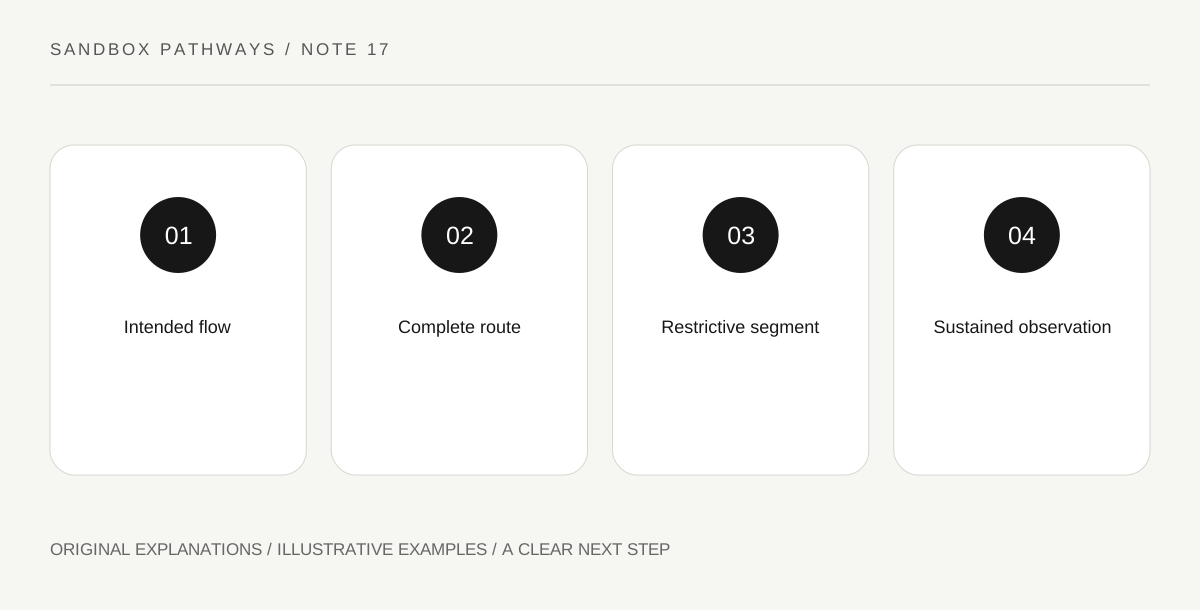
Original explanatory diagram. Read the full method and limitations below.
Name the flow you want to carry
The conveyor reference describes marks with different item-per-minute capacities. Before changing a belt, identify the planned flow and the route carrying it. Keep actual machine demand separate from belt capacity: a belt does not create items simply because it can carry them. Draw the path from source to consumer, marking junctions and short connections. This makes the task a route inspection rather than a visual comparison of whichever belt is easiest to see. A useful diagnosis starts with a specific question, such as whether this entire route can support the planned 120-item-per-minute flow.
Inspect every serial segment
For a simple uninterrupted route, a lower-capacity section can restrict what passes through to later sections. Walk the full route and inspect small pieces near buildings, splitters and height changes. Do not assume that an upgrade applied to a long section also changed every adjoining piece. The exercise is especially useful after several renovations, when the original route is no longer obvious. Keep a short checklist of segments instead of replacing everything at once. If a particular connection is ambiguous, inspect or rebuild that limited section using the intended current mark, then reassess the same route.
Use a simple capacity comparison
The cited conveyor table lists Mk.1 at 60 and Mk.2 at 120 items per minute. In an illustrative 120-flow plan, a remaining Mk.1 section cannot carry the entire intended flow through that serial path. This is a capacity statement, not a promise that upgrading it alone makes the factory produce 120. The source and consumer still need to support the plan. Put the three figures beside one another: intended flow, route capacity and observed sustained delivery. A difference can then point toward a question instead of becoming an unexplained impression that the factory seems slow.
Observe the connected system after a change
After addressing a suspected segment, let the line run and inspect the source, consumers and any backing-up points. Temporary buffers can make the first moments misleading, so avoid declaring success from one short burst. Change one suspected restriction before introducing new machines or different recipes. If delivery remains below the plan, trace the next condition rather than automatically upgrading every belt again. The lesson is to connect each change to a specific capacity question. A tidy route diagram can become part of your factory notes, making a later expansion easier because you know which path was actually checked.
Mark a checked segment on your route sketch only after inspecting it, so a later review can distinguish verified sections from assumptions.
Illustrative factory exercise
An illustrative route aims to carry 120 items per minute and uses mostly Mk.2 belt, but a short Mk.1 piece remains at a junction. Its 60-item capacity limits that serial path. Replace the identified restriction, then verify source supply and downstream demand. The upgrade removes one limitation; it does not certify every other condition in the factory.
Practical checks
Optional checkboxes save only in this browser.
Questions that come up
Can a fast belt increase an undersupplied source?
No. Transport capacity is not item generation. Source supply and demand remain separate conditions.
Does one moving burst prove the planned rate?
No. Buffers can produce temporary behavior. Inspect a sustained period and the connected machines rather than one instant.
References and scope
These sources support the factual background. Examples and exercises are original illustrative teaching material. References do not imply endorsement.
- Official Satisfactory Wiki: belts — Belt mark and throughput limits; indexed official-wiki content read.