Satisfactory: fix the shortage before resetting power
A tripped factory needs more than another pull of the reset control. Read the connected grid, identify the supply-and-demand problem and change that condition first. The power graph becomes more useful when you distinguish capacity, current production and consumption instead of treating them as one number.
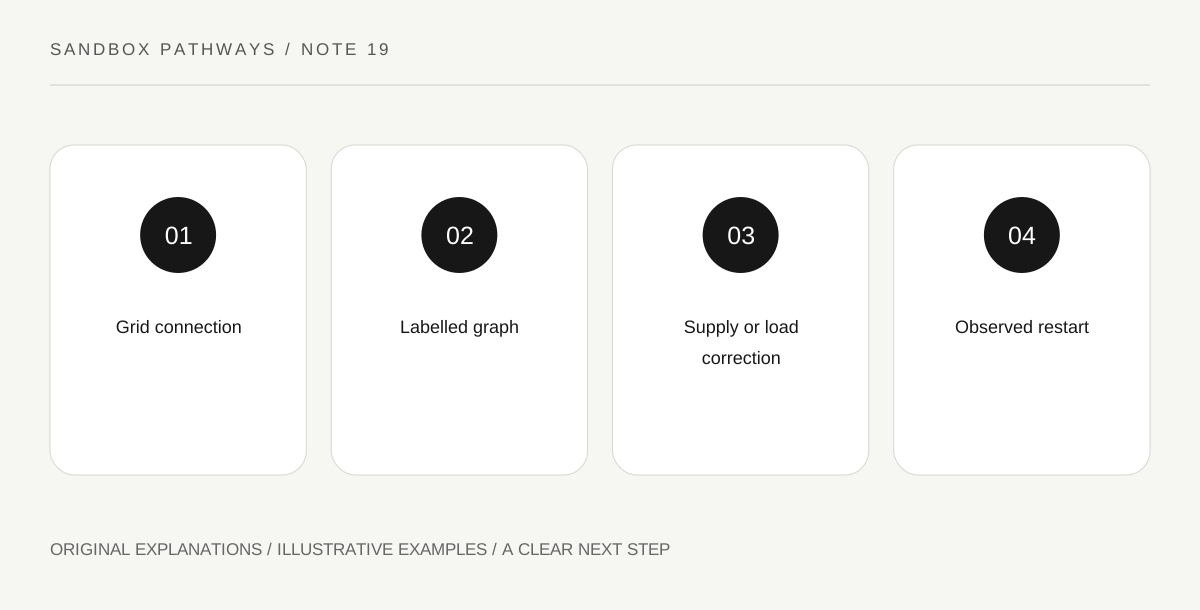
Original explanatory diagram. Read the full method and limitations below.
Check which grid you are inspecting
The power reference describes a grid as connected generating and consuming buildings. A graph concerns that connected system, not every generator visible somewhere in the world. Start at a device on the affected grid and inspect its current connection. A nearby generator that is not connected cannot be assumed to support the line. Likewise, a cable reaching one pole does not prove every intended building is connected beyond it. Sketch the simple connection path you expect, then inspect that path. This makes the first question structural: what belongs to this grid before any numerical comparison is made?
Read the graph’s labels separately
The cited explanation distinguishes capacity, current production, consumption and maximum consumption. Use their actual labels rather than choosing the largest visible number as a general safety margin. Capacity and production can differ, while current demand may be lower than the combined demand of machines that could operate together. In a beginner exercise, copy the displayed values into named fields. You do not need advanced generation calculations to learn what the fields represent. Keep power units attached and avoid confusing power with stored energy. A labelled record lets you compare the same grid before and after a production-line change.
Correct the condition that caused the trip
The reference explains that a shortage without available stored energy can trip the grid, and that the issue should be corrected before resetting. Inspect whether the intended generation can actually operate, including its relevant supplies, and whether the connected demand exceeds what it can provide. One controlled response is temporarily reducing the load while establishing sufficient reliable supply. Do not repeatedly reset an unchanged overloaded arrangement and interpret each failure as a mysterious new bug. A reset is an action after diagnosis; it does not manufacture fuel, reconnect a missing cable or erase the demand of newly added machines.
Test a restart with a clear boundary
After a targeted correction, restart using the supported in-game interface and inspect the affected machines. Reintroduce optional load in understandable steps rather than reconnecting an entire expansion without reading the graph. In an illustrative notebook, mark which group was added and what changed. Keep the record limited to observed conditions; do not turn one successful instant into a guarantee that fluctuating or future demand can never exceed supply. A useful power plan includes room to inspect the next expansion. The learning loop is connection, labelled readings, corrected shortage and observed restart, which is more informative than counting how often the breaker has been pulled.
Illustrative factory exercise
An illustrative grid has 100 MW of available production, current demand of 85 MW and a planned group that could raise simultaneous demand to 110 MW. These are hypothetical teaching figures, not a specific building recipe. Before adding the group, address the supply-demand mismatch. If a trip occurs, resetting without changing that mismatch does not solve its cause.
Practical checks
Optional checkboxes save only in this browser.
Questions that come up
Does a reset create additional power?
No. It restarts after the underlying condition is addressed. It does not add generation, supplies or missing connections.
Does a quiet factory prove future demand fits?
No. Current consumption and potential simultaneous consumption are different information. Read the graph and the planned machines’ needs.
References and scope
These sources support the factual background. Examples and exercises are original illustrative teaching material. References do not imply endorsement.
- Official Satisfactory Wiki: power — Capacity, production, consumption and correcting a shortage before resetting a trip.