Satisfactory: a splitter distributes to available outputs
A basic splitter does not create extra resources or guarantee a permanent three-way flow. It distributes incoming items among its usable outputs, and backed-up branches change that situation. Learn the behavior with a small line before diagnosing a large factory through a single snapshot.
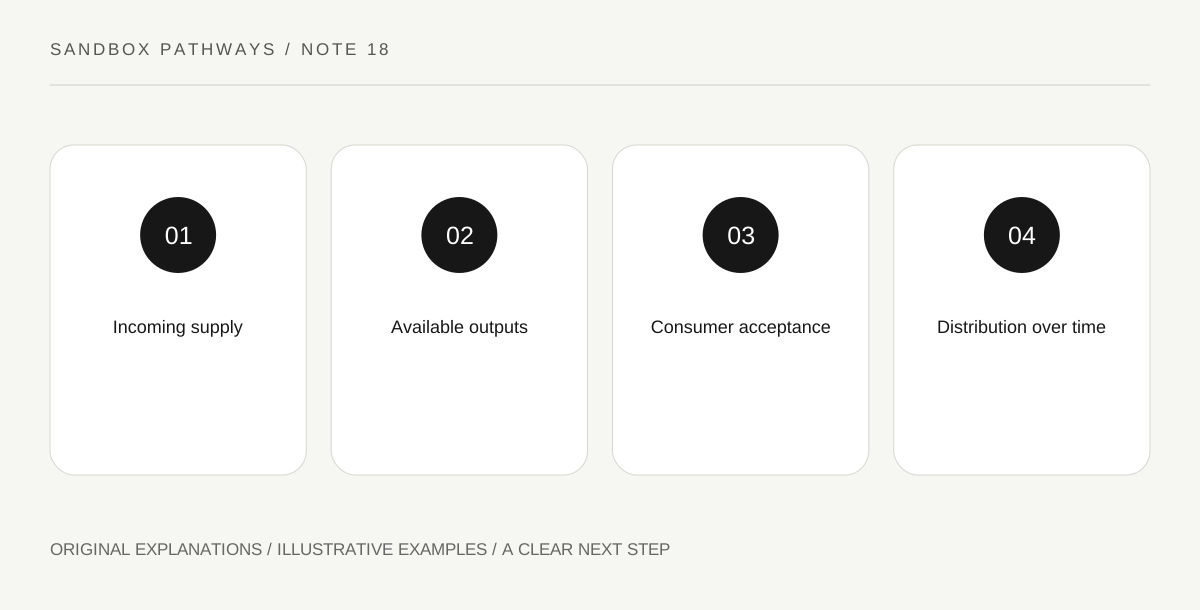
Original explanatory diagram. Read the full method and limitations below.
Identify input and output roles
The splitter reference describes one input and up to three outputs. Begin by locating these roles in the current building view rather than assuming every side is equivalent. A belt connected to the wrong side does not become an input merely because it points toward the factory. For an introductory test, use one known item stream and two clearly distinguishable output branches. Keep the layout open enough to inspect each connection. The test should answer one question about distribution, not simultaneously introduce mixed items, several splitter variants and a complex network of mergers.
Separate division from multiplication
A splitter changes where items go; it does not increase the incoming supply. If an illustrative steady stream delivers 60 items per minute and two unrestricted outputs share it evenly, each receives 30 over time. Three equivalent outputs would share the same total rather than each receiving 60. Write a conservation check under the diagram: the combined outgoing flow cannot exceed the available incoming flow over a sustained period. This simple arithmetic prevents an attractive layout from promising more resource than the miner actually supplies. Always keep transport limits and actual source rate beside the hypothetical division.
Observe what a backed-up branch changes
The reference explains that the basic splitter skips unavailable full outputs and distributes among remaining available ones. A branch filling up therefore changes the distribution opportunity. Do not treat a temporary imbalance as proof that every basic splitter needs a programmable ratio setting. Inspect whether the consumer is taking items and whether its outgoing production is blocked. A full input buffer may be a downstream symptom rather than a failure at the splitter itself. Follow the item’s job through the consumer before adding more splitting equipment. The visible branch is part of a connected system, not an isolated pipe of guaranteed constant flow.
Run a controlled branch test
First observe two unrestricted branches, then deliberately let one destination fill in a simple practice setup. Watch how the other branch behaves, and restore the original condition afterward. Use ordinary materials and a setup you can easily explain. Do not claim exact rates from counting a few animated items; the purpose is understanding the change in availability. Once that behavior is clear, return to the real production line and ask which branch conditions differ. A small test gives the large layout a mechanical explanation, replacing the vague assumption that all outputs should always look equally busy regardless of their consumers.
Illustrative factory exercise
In a fictional steady-state exercise, a 60-item-per-minute source feeds two unrestricted branches that can each accept their share. Draw 30 and 30. When one branch becomes fully backed up, do not continue drawing its former sustained intake as though nothing changed. Reinspect the available routes and the actual consumer conditions before updating the diagram.
Practical checks
Optional checkboxes save only in this browser.
Questions that come up
Does a three-output splitter triple production?
No. It distributes the incoming stream. The combined sustained output remains limited by available supply and transport conditions.
Must every output always receive an equal flow?
Not regardless of conditions. The basic splitter’s behavior changes when outputs are unavailable or backed up. Inspect the connected branches.
References and scope
These sources support the factual background. Examples and exercises are original illustrative teaching material. References do not imply endorsement.
- Official Satisfactory Wiki: splitter — One input, up to three outputs, sequential distribution and blocked-output behaviour.