Stardew Valley: practise fishing-bar control in short bursts
The fishing minigame asks you to keep a moving fish within a controlled bar. New players often overcorrect, holding the input too long and chasing the last movement. A short practice session can separate lifting, holding and descending before adding harder catches or extra rewards.
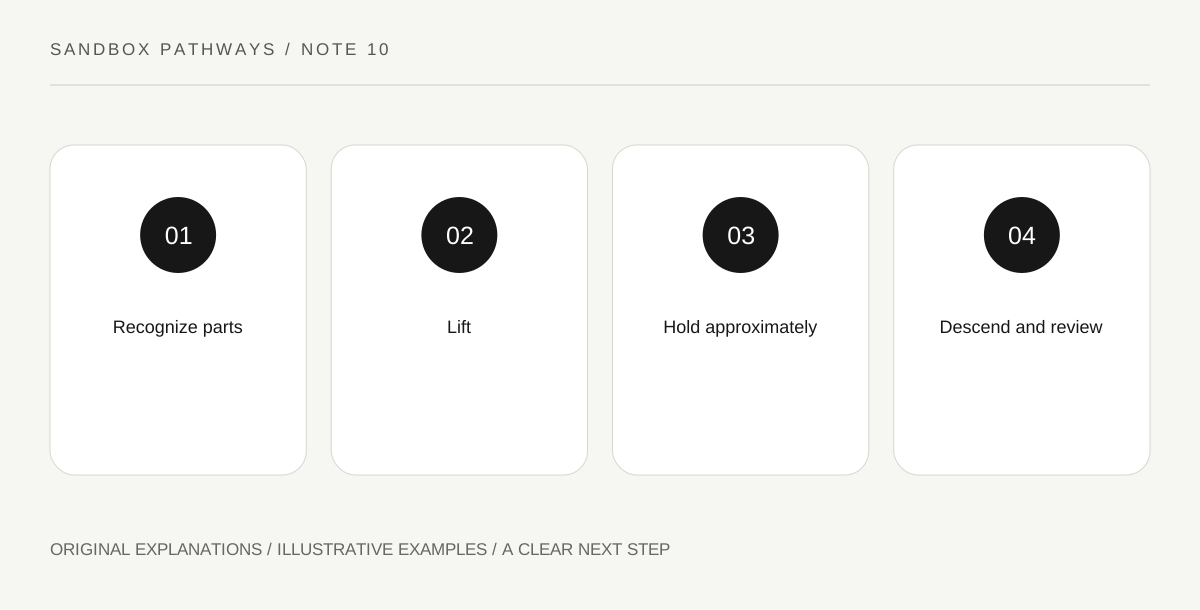
Original explanatory diagram. Read the full method and limitations below.
Name the moving parts
The fishing reference describes the fish icon, movable green rectangle and progress indicator. Learn which one you control before trying to react faster. Input raises the rectangle, while releasing changes its motion; the goal is overlap with the fish. Controls vary by platform, so identify the action in your current settings. The first exercise is observation: watch how a brief press differs from a long hold. You are learning the response of the bar rather than trying to force the fish itself to stop moving. Confusing those roles makes every movement feel like a new unpredictable command.
Break control into three tasks
Practise lifting toward a position, maintaining approximate height and allowing descent. Do not treat the input as only on or off at maximum intensity. Short corrections can be easier to understand than one extended hold followed by a panic reversal. If the fish remains relatively low, notice whether you keep launching the rectangle far above it. If it rises, notice how early you begin adjusting. A useful after-attempt note describes one error, such as overshot after holding too long. That is actionable; simply writing bad at fishing does not identify what the next attempt should change.
Use training support for its actual purpose
The reference describes the Training Rod’s easier bar conditions for low skill and its limits on catches. Treat it as a learning tradeoff rather than an invisible upgrade with no constraints. If available in your game and suitable for the exercise, it can help isolate control practice. Check its current description instead of assuming it supports every fish or every attachment. The goal of the session can be steadier overlap, not maximum value. Matching equipment to a learning task makes it easier to judge progress without confusing practice success with a promise of universal catch access.
Review the attempt before adding distractions
For a first control drill, prioritize keeping the fish engaged rather than chasing an optional extra reward. After each attempt, choose one adjustment: shorter presses, earlier release or a calmer response after a sudden movement. Keep the session small enough that you can still remember the cause of each loss. Conditions such as location, season and time also influence which fish are encountered, so repeated difficulty is not always only an input issue. Separate encounter selection from bar control. This article focuses on the latter; a target-fish search needs its own verified availability information.
Repeat the same small drill before changing equipment again.
Illustrative farm scenario
In an illustrative attempt, the fish pauses low while you hold the input, sending the bar above it. On the next attempt, use a shorter lift and observe the bar’s response before pressing again. Judge the drill by whether you reduce that specific overshoot. A missed catch can still provide useful feedback if the control error becomes clearer.
Practical checks
Optional checkboxes save only in this browser.
Questions that come up
Do upgraded rods automatically enlarge the bar?
The reference distinguishes rod functions from bar-size effects. Do not assume every more advanced rod solves the same control problem.
Does a failed attempt mean no learning occurred?
No. A precise observation about overshoot or timing can guide the next attempt. Use a small identifiable adjustment instead of a vague judgment.
References and scope
These sources support the factual background. Examples and exercises are original illustrative teaching material. References do not imply endorsement.
- Stardew Valley Wiki: fishing — Fishing minigame and Training Rod tradeoffs.