Stardew Valley: count growth nights before buying seeds
A crop’s listed growth time does not include its planting day. Near a season boundary, that small distinction changes whether a planting can be harvested. Practise the calendar calculation before buying more seeds, then leave room for the watering and access the plan actually requires.
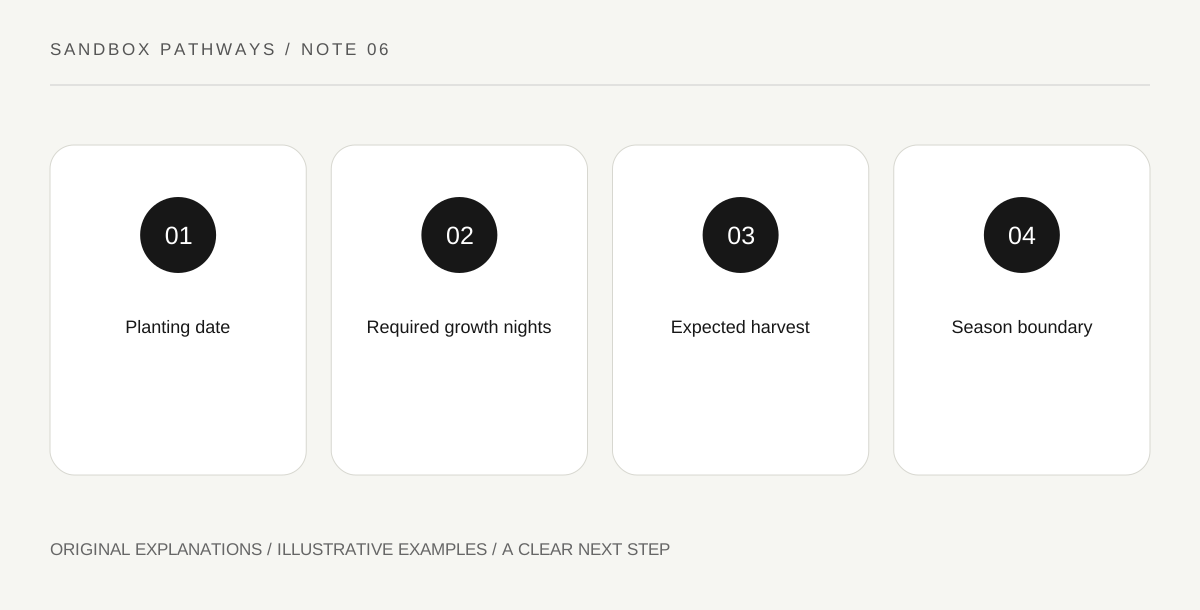
Original explanatory diagram. Read the full method and limitations below.
Count nights rather than inclusive dates
The crop reference explains that planting on day one does not make that day the first completed growth day. A four-day growth period needs four qualifying nights after planting. On paper, mark planting with a small seed symbol and draw one box for each growth night. This is clearer than counting both endpoints aloud, which can accidentally subtract a night. Use the unmodified growth time for the particular crop unless your save has a relevant modifier. Do not combine an accelerated example from one guide with an ordinary seed description from another. Match the calculation to the conditions you are actually using.
Check the season boundary
Ordinary seasonal crops that are no longer in season wither when the season changes; some crops span specified seasons. Read the crop’s actual season information instead of assuming every plant behaves identically. For a late planting, the useful question is whether harvest occurs while that crop remains valid in the current growing location. This introductory exercise concerns ordinary outdoor seasonal planting, not every special growing space or exception. Draw the season boundary as a bold line on your calendar. A planned harvest on the wrong side of that line is a problem even if the arithmetic about elapsed nights is otherwise correct.
Include reliable watering and access
The reference explains that missed watering can delay growth. A calendar plan with no spare night therefore depends on meeting its assumptions. Decide whether the plot fits your normal watering routine before treating the calculation as a guaranteed outcome. Trellis crops add another practical question because their layout can block access. On a sketch, draw your walking route before filling every planting tile. A seed budget that ignores unreachable positions or an overlarge daily routine is not a complete plan. Keep the first late-season exercise small enough that you can inspect every required action and see why the dates work.
Buy for a defined harvest goal
Instead of asking which seed is universally best, choose a concrete goal: one harvest for a bundle, a modest sale or a learning comparison. Calculate the expected harvest date first, then the planting quantity you can manage. If the date fails, spending more money does not repair it. You can choose an eligible crop, postpone the plan or use the remaining time for another task. The point is to make the decision before investing. An orderly notebook records crop, planting date, assumed growth nights, expected harvest date and the condition that must remain true. Those fields reveal which assumption changed if the result differs.
Illustrative farm scenario
For unmodified, daily-watered parsnips with a four-day growth time, planting on Spring 24 gives a Spring 28 harvest. Planting on Spring 25 would put the calculated harvest after spring ends. This example assumes ordinary outdoor conditions and no missed growth nights. The one-day difference matters because the season boundary is part of the calculation, not an afterthought.
Practical checks
Optional checkboxes save only in this browser.
Questions that come up
Does a missed watering always kill the crop?
The crop reference distinguishes delayed growth from immediate death due to one unwatered day. The delay can still ruin a tight season-end schedule.
Can every crop cross into the next season?
No. Some have specified multi-season eligibility, while others do not. Use the particular crop’s information and growing-location context.
References and scope
These sources support the factual background. Examples and exercises are original illustrative teaching material. References do not imply endorsement.
- Stardew Valley Wiki: crops — Season boundaries, growth-night counting, watering and trellis access.