Stardew Valley: learn NPC preferences with the Gift Log
Stardew Valley villagers have individual gift preferences. A repeatable learning routine uses the Social Tab, the Gift Log and a small planned route. Keep evidence about one NPC separate from guesses about the whole town or assumptions based on an item’s price.
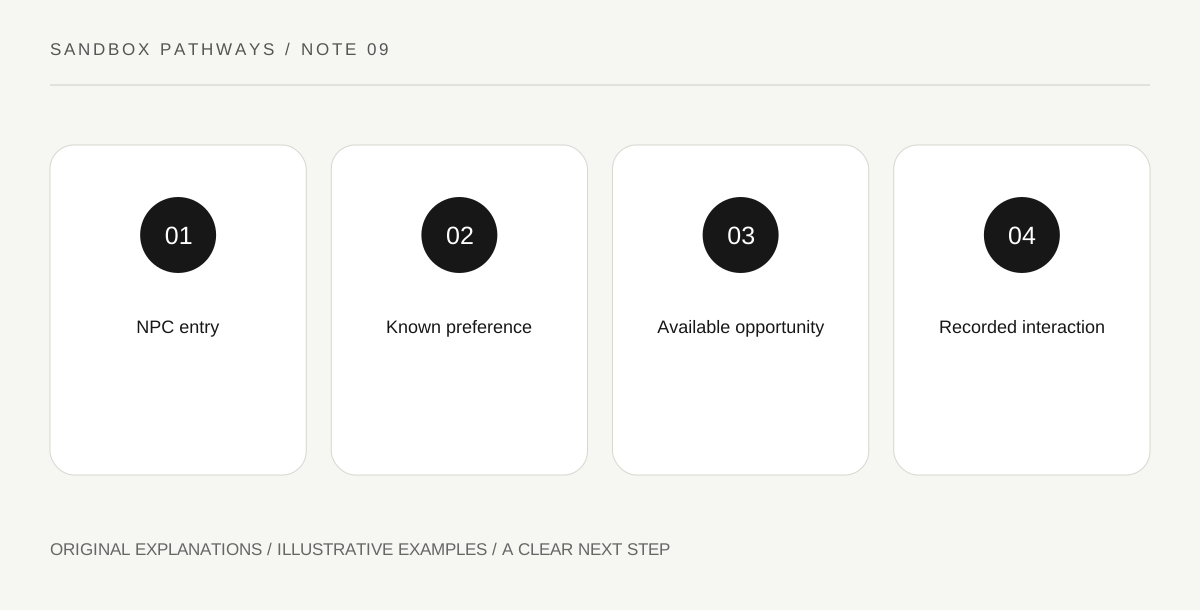
Original explanatory diagram. Read the full method and limitations below.
Choose a small social task
The friendship reference explains individual preferences and the Gift Log in the Social Tab. Start with one or two NPCs rather than trying to optimize every villager immediately. Open the relevant entry and distinguish learned preference information from a guess you made yourself. This makes the activity manageable and gives the next interaction a clear purpose. A town-wide list can be useful later, but it is harder to learn from if you cannot remember where each claim came from. The exercise concerns game NPC systems, not a formula for real-world friendship or communication.
Check the exact intended item
Before giving a gift, compare the item you carry with the preference information for that NPC. Do not infer that an expensive object or an item someone else liked must work identically. Similar categories can contain different individual responses. Keep the selected object deliberate when approaching a character so an accidental interaction does not decide the gift for you. If the information is unknown and you choose to experiment, label the result as an observation for that NPC. A small controlled choice teaches more than rapidly handing out a mixed inventory and losing track of who received what.
Track opportunities without chasing every point
The reference describes the usual daily and weekly gift limits, with exceptions such as birthdays. Use the Social Tab’s indicators instead of relying only on memory. For an introductory routine, check whether an ordinary gift opportunity is available before setting out. You do not need to calculate every point multiplier to learn preferences. If a special occasion matters, check its actual context separately. The important distinction is between a normal routine and an exception. An exception should not silently become the rule applied to every character and every day.
Build a route around another purpose
A useful social route can accompany a town errand rather than consume the entire day searching for one NPC. Decide whom you hope to meet, prepare the intended item and preserve a fallback if the character is not readily available. Do not invent a fixed schedule from one encounter; game conditions can change where people are. After the interaction, inspect the relevant log and your own note. Record what was given and what you learned, then stop. This closes an evidence-based loop and keeps gifting from becoming an escalating list of unexplained assumptions that is difficult to maintain.
Keep the observation attached to the named NPC so it cannot accidentally become a preference claim about everyone.
Illustrative farm scenario
Imagine you have learned one villager likes item A, while another villager’s preference for it is unknown. Prepare A for the first NPC during a planned town errand. Do not duplicate the gift for the second merely because it was convenient. If you choose to test it separately, record that NPC’s response as separate evidence rather than a town-wide rule.
Practical checks
Optional checkboxes save only in this browser.
Questions that come up
Does a higher sale price guarantee a preferred gift?
No. Preference is NPC-specific. Use the game’s preference information rather than a price-based assumption.
Must I optimize all friendship points immediately?
No. A small routine can teach the system. Add detail when it supports your chosen game goal instead of overwhelming the first exercise.
References and scope
These sources support the factual background. Examples and exercises are original illustrative teaching material. References do not imply endorsement.
- Stardew Valley Wiki: friendship — Gift preferences, Social Tab gift log and usual gift limits.