Minecraft: trace a recipe back to its materials
When a Minecraft recipe seems unavailable, the problem may lie earlier in the material chain. Learn to work backwards from the desired output, identify the required ingredients and use the appropriate crafting interface instead of collecting unrelated resources at random.
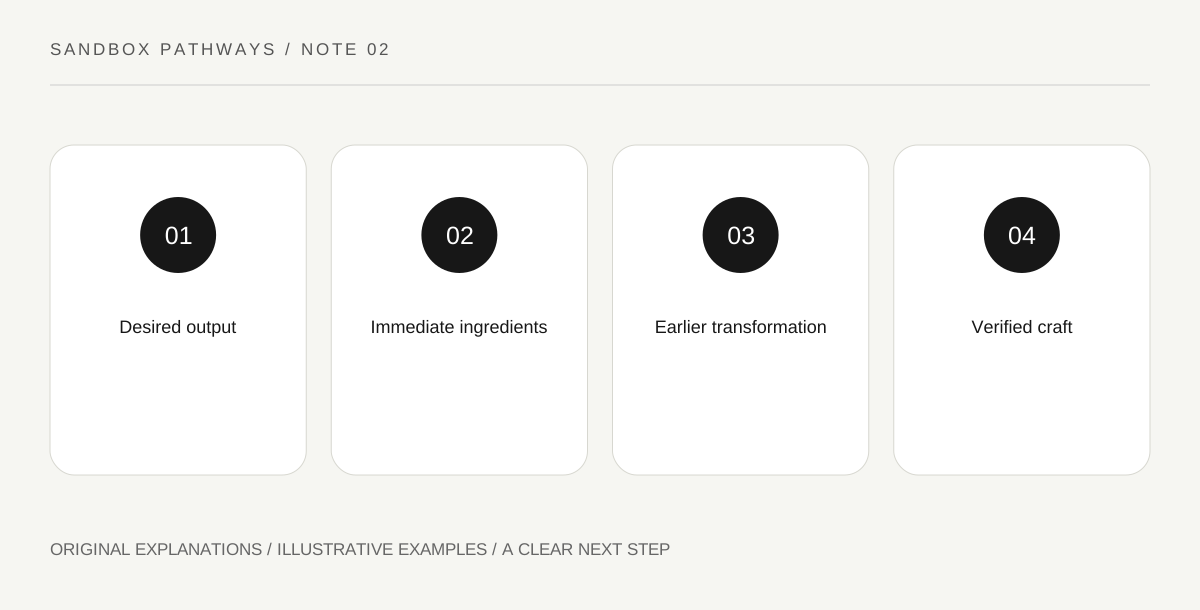
Original explanatory diagram. Read the full method and limitations below.
Name one intended output
Begin with an item you actually need, such as a crafting table. Open the recipe information available in your edition and read the output name before gathering anything. Similar-looking items can require different materials, and an attractive icon is not enough to identify a recipe. The official crafting introduction explains the relationship between recipe and supplies. Your practice task is to make that relationship explicit. Write the desired output at the top of a small dependency sketch, then add its immediate ingredients below. Stop at this first layer before deciding which material you must obtain next.
Work backwards through transformations
For the beginner table example, the official guide shows wood being turned into planks, then planks used for a table. The important idea is that a raw material and a processed ingredient are different inventory items. If you possess the raw material, that does not mean every later ingredient already exists. Follow the chain one transformation at a time. After each step, look at the output in your inventory rather than assuming the conversion happened. This prevents a common loop in which a player repeatedly searches for more raw material while the necessary intermediate conversion is the actual missing action.
Match the interface to the task
Your inventory crafting area and a placed crafting table are related but different workspaces. Use the recipe display for the item rather than assuming that every recipe fits the small inventory grid. Controls and interface placement can vary across editions and platforms, so rely on the current labelled prompts. If a recipe shows missing ingredients, compare their exact names with the items you carry. Do not clear your whole inventory in frustration. A focused check of input type, required amount and appropriate workspace usually gives a more useful explanation than changing several things at once.
Confirm output before repeating
Once the recipe produces an item, move it where you can identify it and check how many were made. Then decide whether another batch is useful. Repeating a craft automatically can consume materials intended for a different step. A good exercise is to write the before-and-after inventory for one conversion, using actual counts shown by your game. This teaches the difference between recipes producing one object and recipes producing several. The goal is not memorizing every recipe immediately. It is learning a repeatable way to inspect a recipe, trace dependencies and verify the result before spending more supplies.
Keep intermediate items visible in the sketch until the final output is confirmed.
Illustrative practice scenario
Suppose you want a crafting table and have a wood block but no planks. Draw wood to planks to table. Perform the first conversion, verify the planks, then perform the second. If you search only for the table without recognizing the intermediate ingredient, you can incorrectly conclude that the material is unavailable despite already carrying its source.
Practical checks
Optional checkboxes save only in this browser.
Questions that come up
Does carrying wood mean carrying planks?
No. They are different items connected by a crafting transformation. Check the actual ingredient shown by the recipe.
Should I memorize all recipes first?
No. Learn to inspect the current recipe and its dependencies. Familiarity develops while using the system for concrete tasks.
References and scope
These sources support the factual background. Examples and exercises are original illustrative teaching material. References do not imply endorsement.
- Minecraft: how to craft — Inventory/table crafting, recipe book and material requirements.